Junior Scientist Lab Book – A Gateway to Scientific Discovery for Young Minds
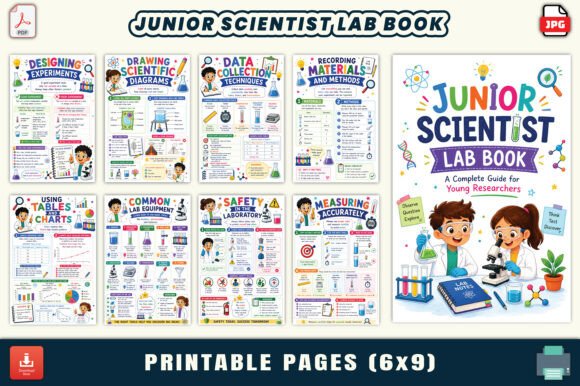
Encouraging a love for science in children is essential for nurturing future innovators, problem-solvers, and thinkers. The Junior Scientist Lab Book offers an engaging and structured approach to introducing young learners to the world of scientific exploration. This 30-page printable eBook, available in JPG and PDF formats, is designed to ignite curiosity, build foundational knowledge, and make the process of learning science both fun and educational. Whether you're a student, homeschooler, or a parent looking to support their child's education, this lab book provides a valuable tool for fostering scientific thinking.
The Junior Scientist Lab Book is more than just a collection of pages—it’s a comprehensive guide that helps children develop essential skills such as observation, hypothesis formation, data analysis, and critical thinking. With its user-friendly layout and clear instructions, it supports both independent learning and guided instruction, making it a versatile resource for various educational settings.
What Makes the Junior Scientist Lab Book Unique?
One of the standout features of the Junior Scientist Lab Book is its well-organized structure. Each page is thoughtfully designed to help children follow the scientific method step by step. From forming a hypothesis to analyzing results, the book walks students through each stage of an experiment in a way that is easy to understand and follow.
The Junior Scientist Lab Book includes sections dedicated to recording observations, collecting data, and drawing conclusions. These guided sections encourage children to think critically about what they are learning and how different variables affect outcomes. By practicing these skills early on, young scientists can develop a strong foundation in scientific reasoning.
Another key feature is the inclusion of lab safety rules and equipment overviews. This ensures that children learn the importance of safety when conducting experiments, which is crucial for any budding scientist. The book also provides practice activities and sample lab entries, allowing students to see real-world examples of how scientific thinking applies to everyday situations.
How the Junior Scientist Lab Book Supports Learning
The Junior Scientist Lab Book is an excellent resource for students who are just beginning their journey into science. It introduces fundamental concepts in a way that is accessible and engaging, helping children grasp complex ideas without feeling overwhelmed. The book's interactive elements, such as tables, charts, and data collection pages, provide hands-on experience with organizing and interpreting information.
For homeschoolers, the Junior Scientist Lab Book is a convenient and effective tool for incorporating science into daily lessons. Its printable format makes it easy to use at home, and the structured layout allows parents to guide their children through each experiment with ease. The ability to reuse the pages also makes it a cost-effective option for families who want to explore multiple science topics over time.
In a classroom setting, the Junior Scientist Lab Book can be used to enhance science projects and experiments. Teachers can assign specific sections for students to complete as part of their coursework, reinforcing the concepts taught during lessons. The book's flexibility allows it to be adapted to different grade levels and learning objectives, making it a valuable addition to any science curriculum.
Why Choose the Junior Scientist Lab Book?
There are several reasons why the Junior Scientist Lab Book stands out among other science resources for children. First and foremost, it encourages critical thinking and curiosity—two essential traits for any scientist. By providing opportunities for experimentation and analysis, the book helps children develop a natural interest in science and a desire to explore further.
The Junior Scientist Lab Book is also highly practical. Its structured layout makes it easy to use, even for beginners. The clear instructions and organized sections help children stay focused and on track as they work through each experiment. Additionally, the availability of both JPG and PDF formats ensures that the book can be used in a variety of ways, whether printed for physical use or accessed digitally for convenience.
Another benefit of the Junior Scientist Lab Book is its adaptability. It can be used for a wide range of science topics, from basic chemistry and biology to physics and environmental science. This versatility makes it a valuable resource for educators and parents who want to introduce children to different areas of science in a structured and engaging way.
Getting the Most Out of the Junior Scientist Lab Book
To maximize the benefits of the Junior Scientist Lab Book, it's important to use it consistently and creatively. One effective approach is to incorporate the book into regular science activities, such as weekly experiments or project-based learning. This helps reinforce the concepts covered in the book and allows children to apply their knowledge in real-world situations.
Parents and teachers can also use the Junior Scientist Lab Book as a starting point for discussions about science and technology. By encouraging children to ask questions and explore answers, adults can help foster a deeper understanding of scientific principles. Additionally, the book's sample lab entries and practice activities provide opportunities for children to practice writing hypotheses, recording observations, and analyzing results.
It's also worth noting that the Junior Scientist Lab Book can be used in conjunction with other science resources, such as online videos, books, and hands-on experiments. Combining different learning methods can enhance the overall experience and help children develop a more comprehensive understanding of science.
The Junior Scientist Lab Book is more than just a tool for learning—it's a way to inspire a lifelong passion for science. By providing a structured yet flexible approach to scientific exploration, it empowers young minds to think critically, ask questions, and discover the wonders of the world around them.